Liveaboard.com

Castle Rock Liveaboard Diving

Our customers rated liveaboard diving in Castle Rock as 9.4.

  • 100% Best Price Guarantee

Liveaboard Diving in Castle Rock

What To Expect On A Castle Rock Liveaboard

Castle Rock liveaboards visit this dive site situated to the North of the islet of Gili Lawa Laut, at the top of Komodo Islands. The area is protected by the Komodo National Park and is internationally renown for diving tours. This area is home to some of the richest coral and fish life in the region and beautiful scenery on land.

The islands and the underwater topography, is volcanic. Many of the best reefs, such as Castle Rock, sit atop huge sea mounts formed by volcanic activity. The Castle Rock sea mount is more of a pinnacle, with steep edges and a stunning coral garden growing on the top from around 5 meters/16 ft. downwards.

The visibility is eye watering, often exceeding 30 meters/98 ft. offering a beautiful view over the pinnacle and the fish life. Currents here are however very strong, as the Castle Rock is one of the most exposed dive sites around Gili Lawa Laut. These currents can be several knots and bring plankton rich waters with them which in turn, bring the big fish!

What You Can See

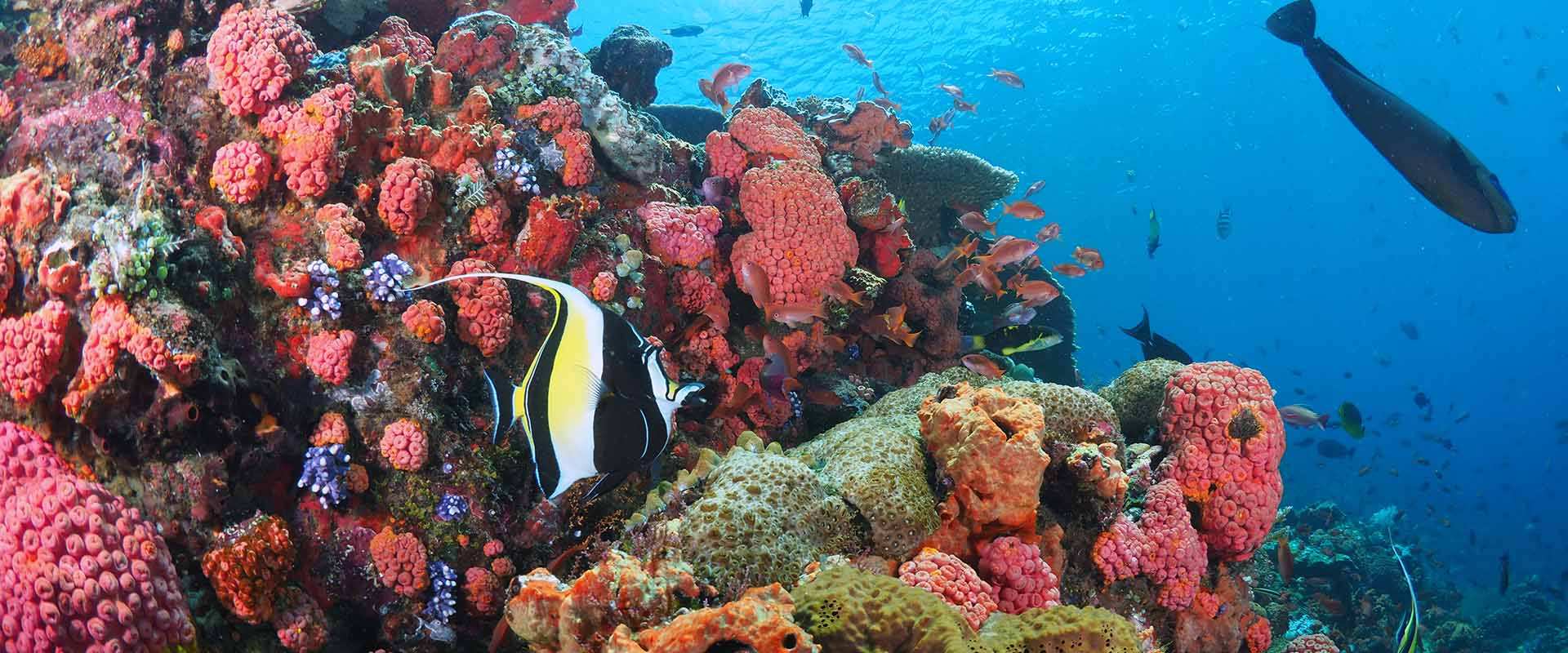
Liveaboard diving at Castle Rock is one of those amazing experiences, where there is a chance to see pretty much anything you can find around Komodo. The reef is beautiful with an array of colourful reef fish living on the hard and soft corals that coat the top end of the pinnacle. The fauna also means great macro opportunities, with critters all over the corals.

Photography here is simply sublime, not only macro, but the number of angel and butterfly fish, often in huge shoals that cover huge portions of the reef, is a sight to behold. Silverside, Jacks, and trevally are all around the reef and out in the blue. The entire reef can sometimes be enveloped in a cloud of different fish.

These shoals also attract bigger animals to the reef, in impressive numbers. Whitetips, blacktips and grey reef sharks can be seen here, and it is not unusual to see all three while diving there. The nutrient rich currents also mean, there is every possibility that divers might see mantas passing by. There are other pelagic fish as well, tuna are frequent visitors and very lucky divers might even be surprised by a pod of dolphins, that is known to come to this reef to hunt.

Getting To Castle Rock

Castle Rock is at the Northern end of Komodo Island in the heart of the Komodo National Park. There are a few options for visiting Castle Rock but by far the best experience, is on a dedicated diving liveaboard tour. There are some day boats leaving from Labuan Bajo though if you only have time for a couple of dive.

There are different kinds of Indonesian liveaboards to suit various needs and budgets. Motor vessels provide a comfortable journey with their custom designed vessels. The most popular diving liveaboards however are traditional Indonesian sailing boats which make for a peaceful and luxurious journey.

Most liveaboards going to Castle Rock embark from either Labuan Bajo or directly from Bali. Often the will start at one port and finish at the other to give you as much time diving as possible during your trip.

Bali International Airport offers flights from many international destinations in Asia and further afield. This is also the place to take a flight to Labuan Bajo as well. For the more adventurous travellers there is also a three-day ferry ride from Bali to Labuan Bajo, although it is not for the faint of heart.


Castle Rock Diving Reviews

  • Rating 9.4 out of 10
  • 9.4 Superb
  • Rating 10.0 out of 10
  • 10.0 Exceptional
  • Paul B
  • Flag of United StatesUnited States

Seamount with strong current. Lots of fish, very healthy reef.
Diving Castle Rock in July on the Cajoma IV
  • Rating 10.0 out of 10
  • 10.0 Exceptional
  • Tomas V
  • Flag of United StatesUnited States

Amazing. We liked all the sites for its unique place, structure and surroundings. All the places were perfectly selected and there was no boaring site at all.

Diving Castle Rock in December on the Mikumba Dua
  • Rating 6.8 out of 10
  • 6.8 Review score
  • Ryan V
  • Flag of United StatesUnited States

Great dive site .Unfortunately our guide spent the entire dive swimming against the current in one spot as usual making it a much shorter dive with a limited experience.

Diving Castle Rock in November on the Sokaraja
  • Rating 10.0 out of 10
  • 10.0 Exceptional
  • Rachel M
  • Flag of United StatesUnited States

My favorite dive site. It was so full of life.

Diving Castle Rock in September on the Queenesia


What to know about diving in Castle Rock

What is Castle Rock in Komodo?

Castle Rock is a seamount dive site in Komodo National Park, sitting near its sister site, Crystal Rock, in the park's northern waters. It's known for powerful currents and large schools of fish and reef sharks, making it a favorite among experienced divers on Komodo liveaboards.

Where is Castle Rock located within Komodo National Park?

Castle Rock is a seamount within Komodo National Park, near the sister site of Crystal Rock. Both are accessed from Labuan Bajo as part of a wider Komodo diving itinerary.

How does Castle Rock compare to nearby Crystal Rock?

Castle Rock and Crystal Rock share a similar current-driven, big-fish character and sit close enough together that many itineraries dive both in a single day. Castle Rock is generally noted more for reef sharks and dense fish schools, while Crystal Rock has a reputation for occasional manta sightings.

What is the depth range at Castle Rock?

As a seamount, Castle Rock rises from deeper water toward the surface, giving divers a range of depths on a single dive along its slopes and summit. Most of the reef action takes place at recreational depths near the top of the formation.

How strong are the currents at Castle Rock?

Currents at Castle Rock are consistently strong, which is exactly what draws in the big schools of fish the site is known for. Dives are typically planned around tidal timing to manage conditions safely.

What certification level is recommended for diving Castle Rock?

Castle Rock is best suited to divers with advanced open water certification or solid drift-diving experience, given its strong currents. Less experienced divers are usually directed to calmer Komodo sites instead.

What marine life will divers see at Castle Rock?

Castle Rock is known for dense schools of fusiliers, trevally, and other reef fish swirling around the seamount, drawn in by the nutrient-rich currents. It's one of the sites that gives Komodo National Park its reputation for big-fish action.

Are reef sharks commonly seen at Castle Rock?

Yes — reef sharks are a regular sight at Castle Rock, patrolling the seamount's slopes where the current concentrates baitfish and other prey. Their presence is one of the reasons the site is popular with more experienced divers.

What is the best time of day to dive Castle Rock?

Dive timing at Castle Rock is generally set around slack tide rather than a fixed time of day, since the site's currents can be too strong to dive safely at peak flow. Guides check tidal charts to find the best window for a given day.

What is the best season for diving Castle Rock?

The dry season, roughly April through October, tends to offer calmer conditions and clearer water for diving at Castle Rock (as of 2026). Even so, strong currents remain part of the experience regardless of the time of year.

Is Castle Rock accessible by day boat, or only liveaboard?

Castle Rock can be reached by both day boat from Labuan Bajo and liveaboard itineraries, making it accessible without committing to a multi-day trip. Many visitors combine it with a Komodo dragon trek on the same day.

What is visibility typically like at Castle Rock?

Visibility at Castle Rock is generally good but can vary depending on the strength and direction of the current on a given day. Divers should expect conditions to shift noticeably between different points in the tidal cycle.

Is Castle Rock a good site for underwater photography?

Castle Rock suits wide-angle photography well, thanks to its large schools of fish and dramatic seamount topography, though the strong current makes it a demanding site to shoot steadily. Strong buoyancy control helps photographers hold position for a shot.

What is the water temperature at Castle Rock?

Water temperature at Castle Rock generally falls within Indonesia's typical 79–86°F (26–30°C) range, though it can run cooler during upwelling events common in the Komodo region. A wetsuit is recommended even in warmer months given the current-driven conditions.

What should divers know before their first dive at Castle Rock?

First-time visitors should be prepared for strong currents and a dive plan built around tidal timing rather than a relaxed pace. It's worth checking in with your guide about that day's conditions, since Castle Rock's currents can shift quickly.

We’re here to help, 24/7.

Connect with our expert travel consultants to plan your next trip.

  • Nicole Laughlin
  • Andrea Martinez
  • Nina Kapp
  • Josue Zarco
  • Juliane Ball
  • Ester Canali
  • Mylene Issartial