Liveaboard.com

Zabargad Liveaboard Diving

Our customers rated liveaboard diving in Zabargad as 9.0.

  • 100% Best Price Guarantee

Liveaboard Diving in Zabargad

What To Expect On A Zabargad Liveaboard

Liveaboards to Zabargad will usually visit here as part of a Southern Red Sea itinerary. It is one of the largest islands in the Red Sea, and offers perhaps some of the best diving. Previously thought to have been formed by volcanic activity, the island was in fact formed by extreme pressures in the mantle, created by tectonic movement. This pressure extruded rock upwards from the mantle to form a huge mountain. The tip of which only breaking through the sea after the entire lower crust was uplifted due to a collision between the African and Asiatic continental plates. The peak remains at 285 metres above sea level.

The uniqueness of how the island was formed attracted ancient miners to extract green gemstones, called peridot, from the peridotite rock. Now that mining no longer takes place, the land is relatively uninhabited with most visitors using the island as a stop off to visit Rocky Island just to the south. This, coupled with the excellent management of the Marine National Park, has created a truly special site with extraordinary offerings for divers to explore on their Zabargad liveaboard cruise. 

What You Can See

Liveaboards to Zabargad Island will normally dive along its southern shore where prevailing northerly winds are blocked. The well-sheltered bay is home to green sea turtles and hawksbill turtles who use the beaches to nest during August.

Just off the southern shore, there is a small wall that drops to 50 feet (15 m), shallowing in gradient to form a gentle slope that continues to around 100 feet (30 m). From here, the reef drops off into the abyss. Visibility hovers at around 65 feet (20 m), creating excellent light conditions to see the astonishing colours of the coral and fish species in all their glory.

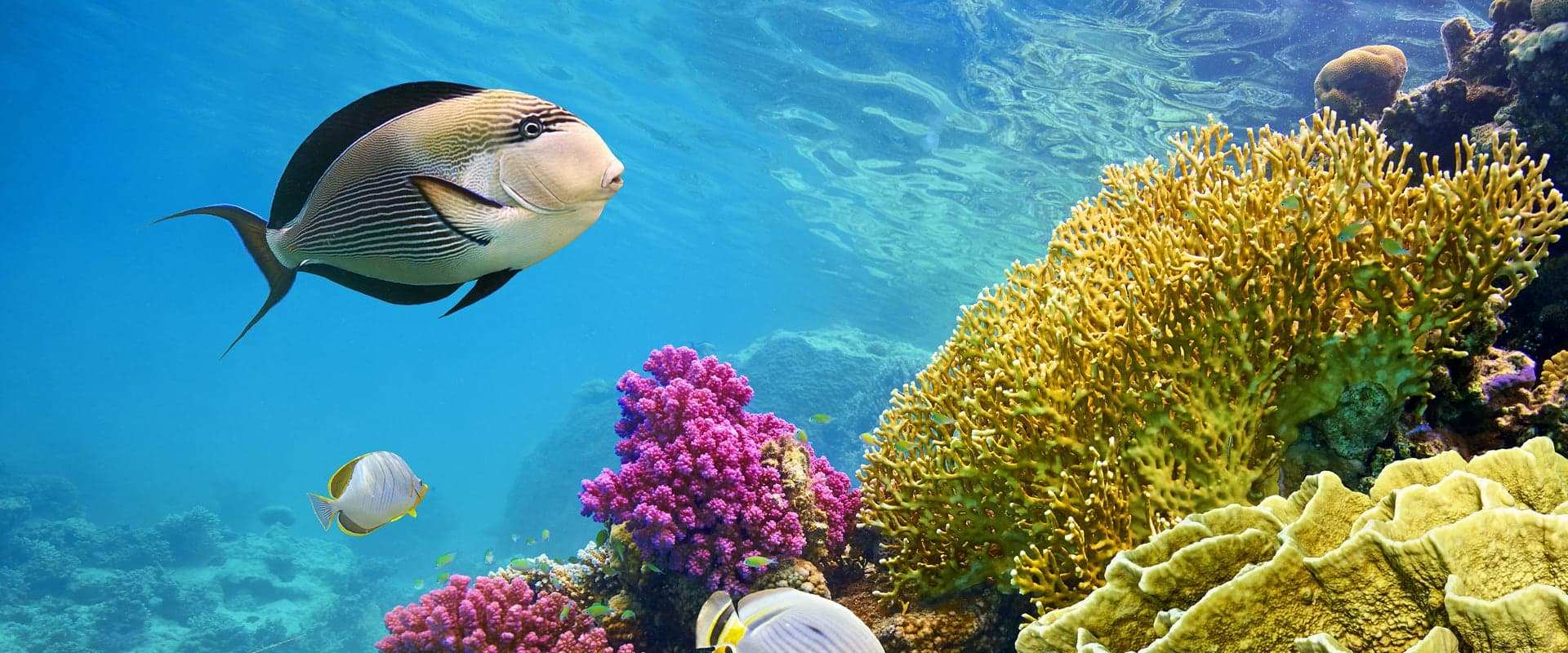
Upon the sandy slopes, you'll find large mounds of coral (known as pinnacles) that attract many smaller species of reef fish, including see-through glass fish, bright orange anthias and electric-blue damselfish. The pinnacles have created many overhangs, cavern areas and tantalising swim-throughs to explore. Wonderfully vibrant nudibranchs, pufferfish, scorpionfish and moray eels have also made the pinnacles their home. Octopus can even be spotted blending into their surrounding environment, changing colour and shape to match the species of coral they choose to sit on.

Swimming along the sandy tracks between the pinnacles are several larger species of fish including barracuda, humphead wrasse (better known as Napoleon wrasse), big grouper, and several types of shark. Hammerhead, oceanic whitetip and grey reef sharks can all be found at Zabargad Island. Camouflaging in the sand are imposing crocodile fish, growing up to half a meter in length, and bluespotted stingrays. Even manta rays have been spotted beyond the bays! Night diving here whilst on a Zabargad liveaboard is very popular, and many invertebrates, such as cuttlefish, octopus and squid, make an appearance.

Furthermore, to the east lies a Russian surveillance ship (known as the Russian Wreck), believed to be the Khanka, which sank in the 1970s. The wreck has been positively identified as a MOMA Class ship, but it's not yet known whether it really is the Khanka or not, due to a lack of publically available records (it is a Russian spy ship after all). Laying in just 80 feet (24 m) of water, the mast breaks the surface during low tide. Glassfish are prolific on this wreck, and it is possible to dive the engine room and bridge. Several other wrecks are rumoured to exist nearby, but the island remains relatively unexplored.

Getting There

Reaching Zabargad Island can only be achieved by Egyptian liveaboard due to the distance from the nearest ports. Liveaboards that visit Zabargad tend to depart from either Marsa Ghalib or Marsa Alam. The nearest airport is Marsa Alam International Airport, which is actually closer to the seaport of Marsa Ghalib, than that of Marsa Alam.


Zabargad Diving Reviews

  • Rating 9.0 out of 10
  • 9.0 Superb
  • Rating 10.0 out of 10
  • 10.0 Exceptional
  • Taj H
  • Flag of United StatesUnited States

I would recommend, but if you want sharks, end of February is not the right time of year.

Diving Zabargad in February on the Blue Seas
  • Rating 10.0 out of 10
  • 10.0 Exceptional
  • Marcin S
  • Flag of PolandPoland

A picturesque high mountain rising from the sea with beautiful reefs around it.

Diving Zabargad in March on the Red Sea Aggressor V
  • Rating 10.0 out of 10
  • 10.0 Exceptional
  • Francesco S
  • Flag of ItalyItaly

More nice dives, night dives really good as well

Diving Zabargad in July on the JP Marine
  • Rating 9.2 out of 10
  • 9.2 Superb
  • Olivier D
  • Flag of BelgiumBelgium

Impressive island with interesting history. Be prepared for "big" encounters and sometimes drift diving

Diving Zabargad in June on the Red Sea Aggressor IV


What to know about diving in Zabargad

What is Zabargad Island?

Zabargad Island (also called St. John's Island) is a remote, uninhabited island in the far southern Egyptian Red Sea, roughly 30-45 miles (50-70 km) offshore near the Sudanese border. At just 1.7 sq mi (4.5 sq km), it's the largest island in that stretch of sea, known equally for its wall diving and its ancient peridot mines — access is by liveaboard only, since there's no airport or scheduled ferry.

What does a Zabargad diving safari itinerary typically include?

A classic "Deep South" liveaboard safari pairs Zabargad with nearby Rocky Island and the St. John's reefs, and sometimes Daedalus Reef, stringing together several days of remote wall and pinnacle dives that shore-based trips can't reach. Expect strong currents and advanced-level sites, with long open-water crossings between reefs; as of 2026, most operators run these routes only in the calmer June-to-September window, when water is around 79-86°F (26-30°C).

What is Jabal Zabargad archaeological site known for?

Jabal Zabargad is the low mountain that covers most of the island, and its slopes hold roughly 150 ancient open-pit mining scars, along with the ruins of small stone-worker settlements. Archaeologists date the clearest surviving evidence of mining to the Ptolemaic and Roman periods, when small crews extracted peridot crystals that were shipped out through the nearby Red Sea port of Berenike.

Is Zabargad Island also known as St. John's Island?

Yes — Zabargad is the Arabic name, while "St. John's Island" (and the older Greek name "Topazios") refer to the same island, a naming legacy dating back centuries, shaped by classical and European visitors drawn by its gem deposits. Dive itineraries and liveaboard schedules are often used interchangeably, so it's worth confirming which term is meant when booking a trip.

Is there evidence of ancient mining on Zabargad Island?

Yes — excavations on Zabargad have uncovered around 150 open-pit mines and the remains of small stone dwellings, evidence that miners worked the island's peridot deposits for centuries. The clearest archaeological evidence dates to the Ptolemaic and Roman eras (roughly 250 BCE-500 CE), with mining activity apparently ending around the mid-6th century AD, coinciding with the decline of the nearby port city of Berenike.

Why is Zabargad Island famous for peridot?

Zabargad's peridotite rock — mantle material thrust to the surface by ancient tectonic activity — contains gem-quality olivine crystals that ancient miners prized as "topazios," the historical source of what's now called peridot. It's one of the world's oldest documented gem sources, worked on and off for roughly two millennia until Egypt nationalized its mines in 1958, when industrial extraction stopped; today, the legacy survives mainly in museum collections and in the mining pits still visible on the island.

We’re here to help, 24/7.

Connect with our expert travel consultants to plan your next trip.

  • Juliane Ball
  • Farah Celada-Benito
  • Mylene Issartial
  • Josue Zarco
  • Andrea Martinez
  • Nicole Laughlin
  • Ester Canali