Liveaboard.com

Charles Darwin Research Station Cruises

Our guests rated adventure cruises in Charles Darwin Research Station as 9.3

  • 100% Best Price Guarantee

Adventure Cruises in Charles Darwin Research Station

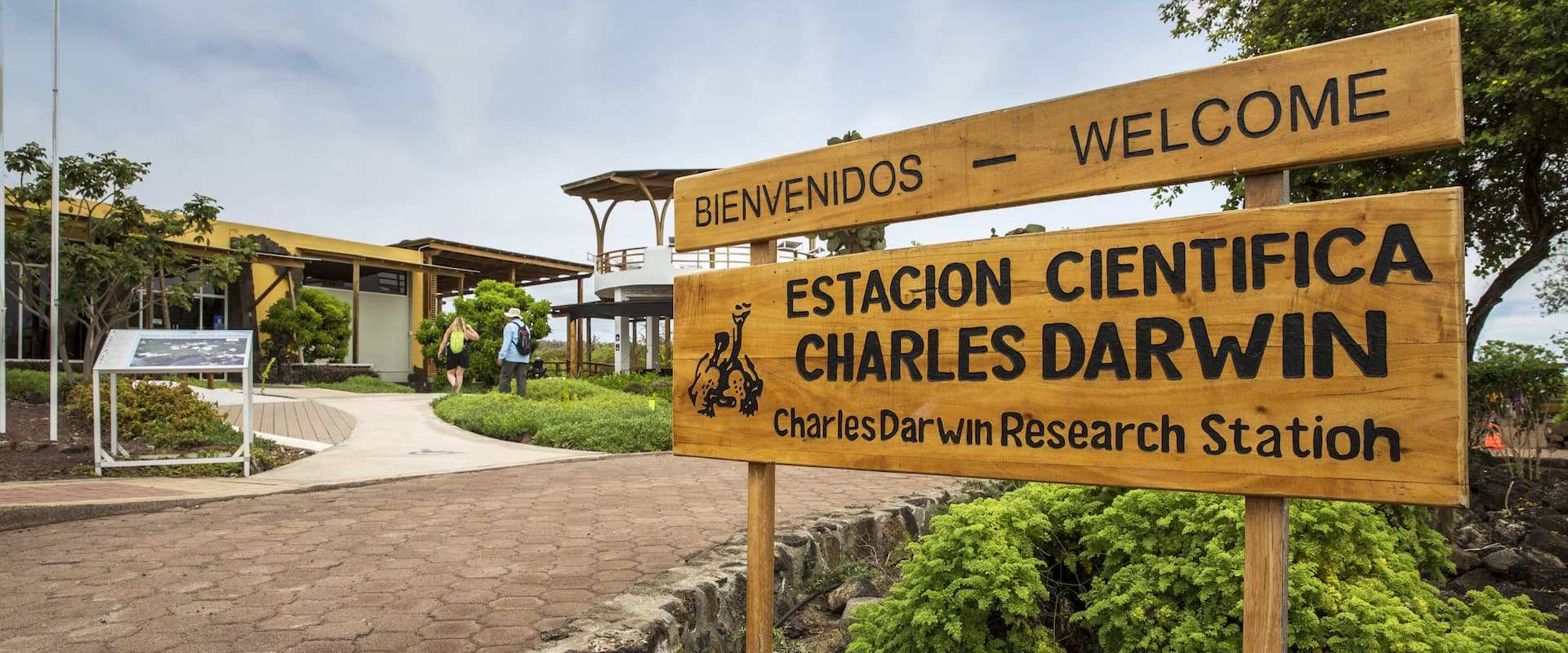
Operated by the Charles Darwin Foundation and staffed by over two hundred scientists and volunteers, the Charles Darwin Research Station manages the Giant Tortoise Breeding and Rearing Program. The research station is located just northeast of Puerto Ayora, on the island of Santa Cruz. A true success story, the Charles Darwin Research Station’s conservation efforts have restored the once flagging giant tortoise population from fourteen to over one thousand. As the best place to get up close and personal with these gentle giants, the research center remains a highlight of small ship cruise itineraries.


Top things to do and see at Charles Darwin Research Station

The Charles Darwin Research Station is the site of one of the Galapagos Islands’ most iconic wildlife encounters and home to one of its most iconic residents: the giant tortoise. Paths through arid landscapes take you to tortoise enclosures where you can view these Galapagos giants, some as much as four feet in length and nearly a hundred years old. For a cuteness overload, the Galapagos Tortoise Breeding Center offers visitors the opportunity to see baby tortoises. The babies measure as little as four inches and are repatriated to the wilds of the Galapagos once they are large and old enough.

Lonesome George was one of the Charles Darwin Research Station’s most famous residents until his death in 2012. The last remaining member of his subspecies, it is estimated that George was at least 80 and possibly over one-hundred years old when he passed. Since his passing, other tortoise species closely related to George have been discovered.

Though meeting the famous giant tortoise would surely be enough, visitors will also see land iguanas in recreated environments and learn about the islands’ endemic flora and geology.

Of course no stop on a Galapagos adventure cruise would be complete without some adventure activities! After visiting with the giant tortoise and land iguana, make your way to the nearby black sand beach for some excellent snorkeling.

Top Tips for visiting Charles Darwin Research Station

  • Bring a good camera—or at least a decent camera phone—to capture a selfie or three with the giant tortoise!
  • Don’t forget to bring your bathing suit and towel so as to enjoy the nearby black sand beach.
  • Note that the Charles Darwin Research Station is open from 6am to 6pm.

Best time to visit Charles Darwin Research Station

The best time to visit Puerto Ayora is whenever you want! Given that the Charles Darwin Research Station is a largely controlled environment, its attractions and wildlife encounters can be enjoyed any time of year.

It is, however, always a good idea to plan ahead. For instance, January to March offers excellent water visibility and the warmest water temperatures, so it’s the best time for snorkeling at the black sand beach. Meanwhile, January to April brings intense sunshine, so it’s best to pack extra sunblock and a hat for this time of year.

Where do cruises that visit Charles Darwin Research Station depart from?

Most Galapagos small ship cruises to the Charles Darwin Research Station leave from one of three points: from San Cristobal Island, from Baltra, or from Puerto Ayora, on Santa Cruz Island.

If your cruise departs from San Cristobal, you will fly into the San Cristobal Airport, near the port city of Puerto Baquerizo Moreno.

Cruises departing from Baltra and Puerto Ayora are serviced by the airport on Isla Baltra. Puerto Ayora is approximately an hour away from the airport. Cruises leaving from Puerto Ayora will typically include the Charles Darwin Research Station early on their cruise itineraries.

These points can be reached via flights from mainland Ecuador, specifically Quito or Guayaquil.

Book your next adventure cruise to the Galapagos today.


Operated by the Charles Darwin Foundation and staffed by over two-hundred scientists and volunteers, this research station is located just northeast of Puerto Ayora, on the island of Santa Cruz.

Charles Darwin Research Station Adventure cruise reviews

  • Rating 9.3 out of 10
  • 9.3 Superb
  • Rating 10.0 out of 10
  • 10.0 Exceptional
  • Cynthia F
  • Flag of United StatesUnited States

Lots of information. Loved seeing the turtles

Cruising Charles Darwin Research Station in November on the Monserrat
  • Rating 7.2 out of 10
  • 7.2 Good
  • Scott J
  • Flag of United StatesUnited States

It gave us a great insight into conservation efforts, and full of giant tortoises.

Cruising Charles Darwin Research Station in June on the Seaman Journey
  • Rating 8.0 out of 10
  • 8.0 Very good
  • Roger B
  • Flag of United StatesUnited States

Found it interesting and educational. We loved the trek to the highlands and the giant tortoise

Cruising Charles Darwin Research Station in May on the EcoGalaxy
  • Rating 8.4 out of 10
  • 8.4 Very good
  • Chelsea P
  • Flag of United StatesUnited States

Slightly tedious. Mostly there to see baby tortoises.

Cruising Charles Darwin Research Station in May on the Archipel I


What to know about adventure cruising in Charles Darwin Research Station

Who discovered the Galapagos Islands?

The Spanish bishop of Panama, Tomás de Berlanga, stumbled onto the archipelago on March 10, 1535, when his ship drifted off course. He named them after the saddle-backed tortoises (galápago is an old Spanish word for saddle).

Who studied the Galapagos Islands?

Charles Darwin is the famous one — he visited in 1835 aboard HMS Beagle, and his observations of finches and mockingbirds later shaped On the Origin of Species. Today, the Charles Darwin Foundation, founded in 1959, continues that legacy with year-round research on giant tortoises, marine iguanas, and invasive-species control.

When were the Galapagos Islands discovered?

The first recorded European sighting was in 1535 by Tomás de Berlanga. The islands appeared on a world map by 1570, and pirates and whalers used them as hideouts and resupply stops for the next 300 years.

Where is the Charles Darwin Research Station?

The station sits on the eastern edge of Puerto Ayora on Santa Cruz Island, about a 1.5-mile (2.4 km) walk from the main pier along Avenida Charles Darwin. It's the working headquarters of the Charles Darwin Foundation and the most-visited science site in the archipelago.

When did Charles Darwin visit the Galapagos Islands?

Darwin arrived on September 15, 1835, and stayed aboard HMS Beagle for about five weeks, visiting San Cristóbal, Floreana, Isabela, and Santiago. He was 26 at the time, and the trip was part of a nearly five-year round-the-world survey voyage.

Why did Charles Darwin go to the Galapagos Islands?

He was the unpaid naturalist on HMS Beagle, whose mission was to chart South American coastlines for the British Admiralty. The Galapagos was a routine survey stop — Darwin was simply collecting specimens, with no idea the islands would later define his career.

What did Darwin observe on the Galapagos Islands?

Darwin spent five weeks in 1835 cataloging finches with subtly different beaks on different islands, plus mockingbirds, giant tortoises, and marine iguanas — none of which he found anywhere else in the world. Those island-by-island variations seeded his idea that species adapt to local conditions over time.

What did Charles Darwin discover on the Galapagos Islands?

He didn't have a eureka moment on the islands — the insight came years later when ornithologist John Gould told him each finch was a separate species. The combination of distinct island-by-island finches, mockingbirds, and tortoises eventually became the cornerstone evidence for natural selection in his 1859 book.

How many species of finches are on the Galapagos Islands?

There are 17 recognized species of Darwin's finches across the archipelago, ranging from the cactus finch to the sharp-billed vampire finch on Wolf Island. They evolved from a single ancestor that arrived roughly 2 to 3 million years ago.

How did organisms arrive at the Galapagos Islands?

The islands are volcanic and have never been connected to the mainland, 605 miles (974 km) away, so every species got there by sea, by air, or by accident. Currents carried floating debris with reptiles aboard, birds flew in or were blown in, and seeds rode on feathers and in droppings.

We’re here to help, 24/7.

Connect with our expert travel consultants to plan your next trip.

  • Andrea Martinez
  • Farah Celada-Benito
  • Juliane Ball
  • Josue Zarco
  • Mylene Issartial
  • Ester Canali
  • Nicole Laughlin